
Enzymatic recycling of PHA in ReBioCycle: A chat with Laura de Eugenio (CSIC)
We had a short catch-up with Laura de Eugenio (CIB-CSIC) on her work on enzymatic recycling.
What are the main challenges faced by the enzymatic recycling of bioplastics, in your opinion?
LdE: Two significant challenges are represented by the enzyme efficiency and stability, and the process scalability.
Most depolymerases exhibit low activity on bulk or crystalline bioplastics and are often unstable under industrial conditions. The addressing of this challenge requires protein engineering and process optimization.
Additionally, large-scale enzymatic recycling must compete with mechanical and chemical routes and deliver consistent yields at low cost. This requires the integration with biorefinery concepts and market acceptance.
A light challenge is the substrate accessibility. Bioplastics are highly hydrophobic and semi-crystalline, which hinders enzyme binding and penetration. Thermal, chemical, or mechanical pretreatments can be implemented quickly and are effective.
What are the main results of your research that are key to the validation of this technology?
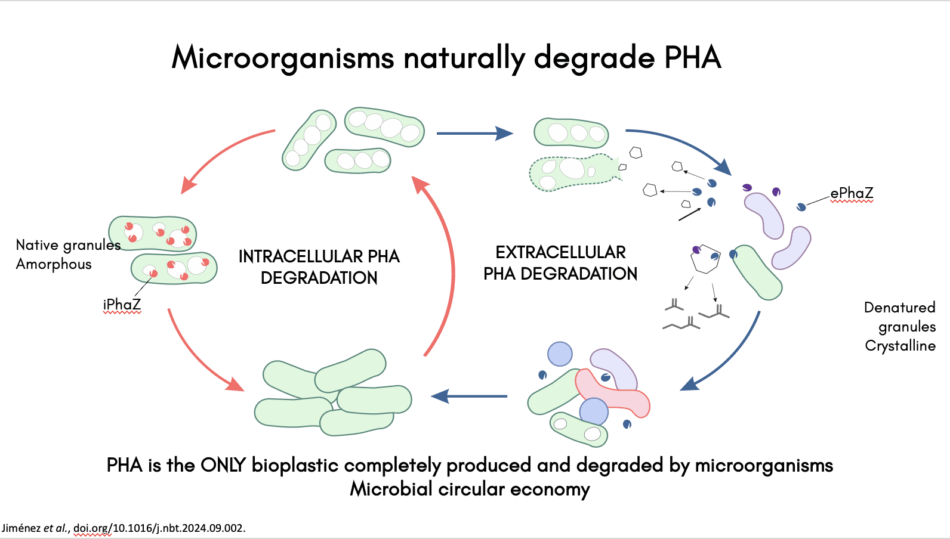
LdE: Our research in ReBioCycle has aimed to explore the possibilities of enzymatic recycling of PHA under conditions that resemble practical applications. We worked with enzymes obtained through heterologous expression systems and applied them without purification to keep the process closer to scalable production schemes. The material was examined in both its original form and after pretreatments that alter its structure and surface properties, allowing us to see how such changes affect its interaction with enzymes. Throughout the work, we followed the generation of soluble products as a simple indicator of progress in depolymerization. Rather than focusing on maximizing individual parameters, the intention was to understand how the different elements, such as enzyme preparation, polymer conditioning, and product recovery, fit together in a single process. This provides a first step toward evaluating feasibility, while also highlighting aspects that will require longer-term innovation before the approach can be translated into larger-scale practice.
What were the priorities for your activities in ReBioCycle in the past 10 months?
In the past ten months, our activities in ReBioCycle have followed a stepwise set of priorities. We began by identifying the most suitable catalyst from our available enzyme collection. Once a lead candidate was chosen, efforts were directed to improving heterologous production systems to achieve higher efficiency. The next step was to scale up the enzyme supply to move closer to practical application. With this in place, we focused on testing the enzymatic recycling of PHA under two conditions: in its native form and after pretreatment. These comparisons allowed us to observe how differences in polymer state influence the process. Together, these activities created a logical progression from enzyme selection, through production optimization, to application on relevant substrates. The overall priority has been to connect these stages into a coherent workflow that supports the goals of ReBioCycle.
What are the priorities in your activities in ReBioCycle for the upcoming 12 months?
LdE: In the coming twelve months, our priorities within ReBioCycle will build on the progress already achieved. A significant focus will be on further scaling the production of the selected enzymes, ensuring that supply can meet the needs of larger trials. In parallel, we will work on scaling the enzymatic reactor, moving closer to conditions relevant for industrial applications. Another priority will be to test additional pretreatment strategies to compare their effect on polymer accessibility and identify the most effective options. Alongside these applied tasks, we also plan to investigate the enzymatic mechanism in greater detail. Understanding how the catalyst interacts with the substrate at a molecular level will provide insights that can guide future optimization. Altogether, these priorities combine technical scaling, process refinement, and mechanistic understanding, setting the stage for the next phase of ReBioCycle.
About Laura de Eugenio
Laura de Eugenio is a senior researcher at the Center for Biological Research (CIB). CIB is one of the most prestigious and historical research centers of the Spanish National Research Council (CSIC). Laura’s profile is on Google Scholar.
Find out more about Laura’s and CIB’s role in ReBioCycle: a 3- minute interview.
Resources
José D. Jiménez, Manuel S. Godoy, Carlos del Cerro, M. Auxiliadora Prieto,
Hints from nature for a PHA circular economy: Carbon synthesis and sharing by Pseudomonas solani GK13, New Biotechnology, Volume 84, 2024, https://doi.org/10.1016/j.nbt.2024.09.002.